

A website can take Stripe and PayPal payments only into a Stripe or PayPal account that the business itself owns, and whether a Bangladesh-based business can open and receive money in such an account depends on each company's own country rules. When we checked in October 2026, Bangladesh was not on Stripe's list of supported countries and PayPal accounts registered in Bangladesh could not receive payments, so check their official country pages first. Sellers who need them often use a company registered in a supported country, which adds cost, tax and compliance work. For most Bangladeshi businesses the simpler route is a local payment gateway that accepts cards from abroad. Never use someone else's account.
If you sell handicrafts, clothing, digital products or services to people abroad, sooner or later a buyer asks: "Can I pay by PayPal?" or "Do you take cards?" Search online and you will find confident advice that ranges from useful to risky. This guide sets out the honest picture as of October 2026, the routes Bangladeshi sellers actually use, the risks of each, and how to decide. Payment providers change their country lists and rules, so treat this as a starting point and confirm with the providers themselves.
Information checked in October 2026. Provider availability, fees and rules change; confirm with each provider and your bank. This is general information, not legal, tax or financial advice.
In this article
The situation in 2026
Stripe
Stripe lets businesses open accounts only in the countries on its supported list. When we checked in October 2026, Bangladesh was not on that list, which means a business registered only in Bangladesh could not open its own Stripe account and receive payouts to a Bangladeshi bank. The list changes, so check Stripe's own page before you decide. Stripe does offer a service for founders worldwide to form a company in the United States, which can then use Stripe; that is a company in another country, with its own obligations.
PayPal
PayPal's availability varies by country and by what an account can do. When we checked in October 2026, accounts registered in Bangladesh could not receive PayPal payments; PayPal's own country page has the current rules. Money can be sent to Bangladesh through some remittance services, but that is not the same as accepting PayPal at a website checkout.
What this means
The website side is not the problem: a website builder can add a Stripe or PayPal checkout. The question is whose account the money goes into. If your goal is "add a PayPal button and get the money into an account opened by my Bangladeshi business", the provider's country rules decide whether that is possible, and in October 2026 they did not allow it. The question becomes which alternative fits your volume and your buyers.
Routes sellers use (and their risks)
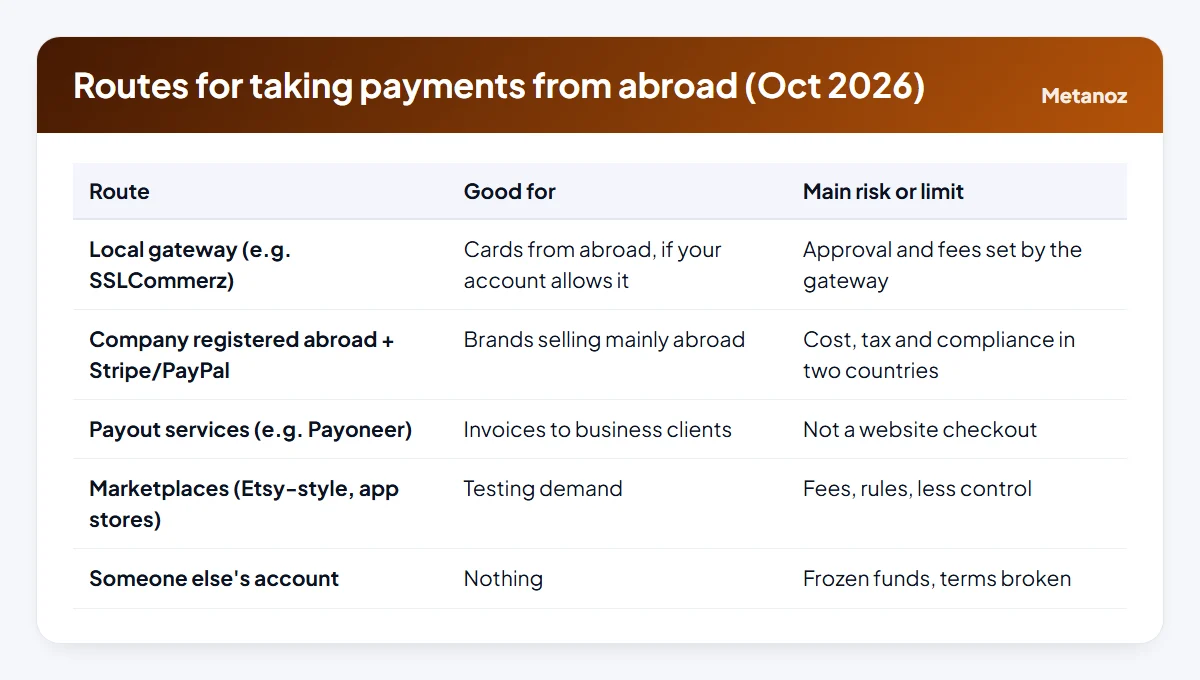
1. A local gateway that accepts foreign cards
Bangladeshi payment gateways such as SSLCommerz process card payments and settle into your local bank account. Whether cards issued abroad are accepted, and on what terms, depends on your merchant agreement, so ask the gateway directly. For many small exporters this is enough: buyers abroad pay with Visa or Mastercard, and you receive taka through normal banking channels.
2. A company registered abroad
Some founders register a company in a country where Stripe and PayPal operate, open a bank account there, and use both. This can work well for brands that sell mostly abroad at meaningful volume. It also means formation and yearly fees, tax filings in that country, and rules on bringing money into Bangladesh. Get professional advice in both countries before you start.
3. Payout services for invoices
Freelancers and service businesses often use payout services such as Payoneer to receive money from clients and marketplaces abroad, then withdraw to a local bank. These are built for invoices and platform payouts, not for a shopping cart on your own website.
4. Marketplaces
International marketplaces handle payment for you. They are a reasonable way to test whether people abroad want your product, at the cost of fees, their rules and less control over your customers.
5. Borrowed or "rented" accounts: avoid
Using a relative's or a stranger's Stripe or PayPal account, false addresses, or tools to hide your location breaks the providers' terms. Accounts used this way can be limited or closed, often with money held. You also have no legal claim to funds in someone else's account. It is not worth it.
Local alternatives for card payments
For a typical Bangladeshi business with mostly local buyers and some buyers abroad, the practical setup is:
- For local buyers: cash on delivery, bKash and Nagad. Our guide to bKash payment gateway integration explains the options.
- For cards (local and, where your agreement allows, from abroad): a local gateway account in your own business's name.
- For larger business clients abroad: bank transfer or an invoice paid through a payout service.
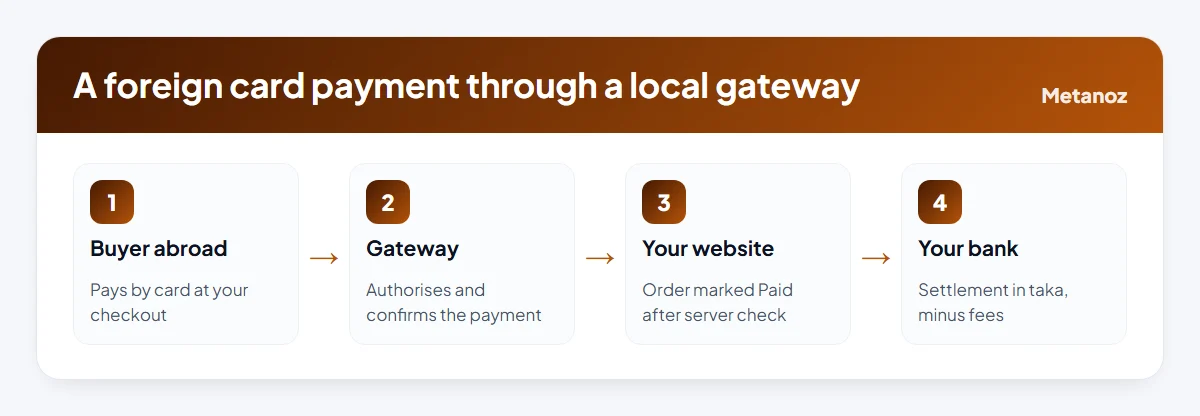
Whatever you choose, an order should be marked paid only when the gateway confirms the payment server to server, not when the buyer's browser returns to a "success" page. For a wider comparison of local providers, read payment gateways in Bangladesh.
When an international gateway makes sense
Worth the effort when
- Most of your buyers are abroad and expect PayPal or Apple Pay-style checkout
- Monthly foreign sales are large enough to cover company and accounting costs
- You already have, or genuinely need, a company in that country
Probably not yet when
- Most buyers are in Bangladesh
- Foreign orders are occasional
- A local gateway accepting foreign cards covers your buyers
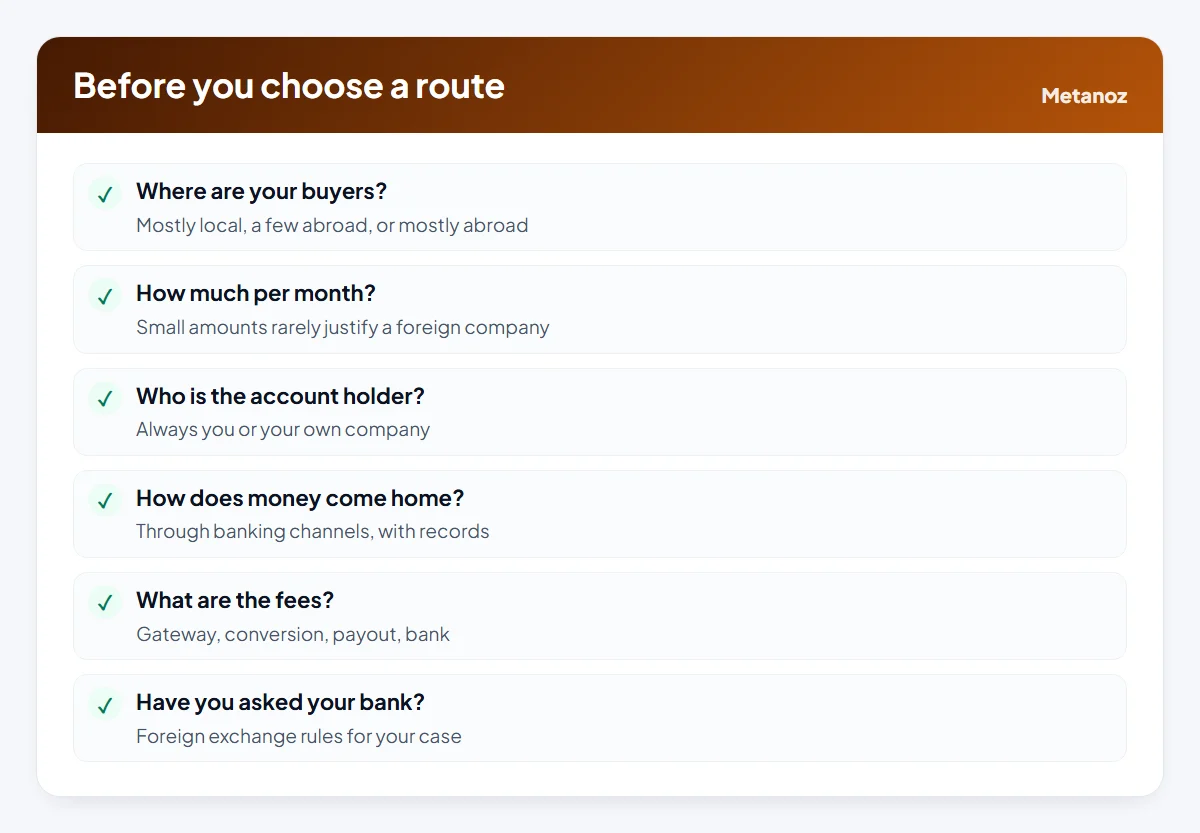
Whichever route you take, decide first how the money will reach Bangladesh and how you will keep records. Export earnings normally need to come through banking channels; your bank can explain what documents it needs for your case.
Beyond payment: what buyers abroad need
Payment is only one part of selling abroad. Buyers in other countries also need prices in a currency they understand, clear shipping costs and times to their country, an English (or their own language) version of your product pages, and a privacy policy that covers their data. Our guide to selling abroad from Bangladesh walks through shipping, documents and pricing.
How Metanoz fits
Metanoz connects to your own SSLCommerz merchant account: you enter your Store ID and Store Password, the connection is tested when you save, and every payment is verified server to server before the order is marked Paid. Card, bKash, Nagad and bank payments go through the gateway into your account; see the SSLCommerz setup guide. bKash and Nagad by Send Money with TrxID, and cash on delivery, are also built in, with no commission from Metanoz.
Metanoz also has an International Payments app (from the Business plan; contact us for pricing) that lets your shop accept Stripe (cards) and PayPal payments straight into your own Stripe and PayPal accounts; an order is marked Paid only after the gateway confirms it. It is useful once you have such accounts, for example through a company abroad. Whether your business can open them is decided by Stripe and PayPal under their country rules, not by Metanoz. Multi-currency prices, international shipping rates and a privacy and GDPR app are available too; see selling worldwide. Metanoz does not provide Stripe or PayPal accounts, and cannot make them available in Bangladesh.
What to do next
Write down where your buyers are, roughly how much you sell abroad each month, and how they would prefer to pay. If most are local, set up bKash, Nagad, cash on delivery and a local card gateway first. If foreign sales grow to a level that justifies it, talk to an accountant and your bank about a company abroad before you open any account.
Start your website today
Pick a template and a name; Metanoz sets up the rest. 7 days free, no card needed.
Start freeSee templatesFrequently asked questions
Is PayPal available in Bangladesh?
It depends on PayPal's country rules. When we checked in October 2026, PayPal accounts registered in Bangladesh could not receive payments. Check PayPal's own country page for the current situation, as this can change.
Can I use Stripe in Bangladesh?
That depends on Stripe's supported country list. When we checked in October 2026, Bangladesh was not on it, so a business registered only in Bangladesh could not open its own account. Some founders form a company in a supported country and use Stripe through it, which has its own costs and obligations.
How can I accept international card payments in Bangladesh?
Ask a local gateway such as SSLCommerz whether your merchant account can accept cards issued abroad, and on what terms. Payments then settle into your local bank account.
Is it safe to use a friend's PayPal account?
No. It breaks PayPal's terms, the account can be limited with money held, and you have no legal claim to funds in someone else's account.
Do I need a foreign company to sell abroad?
Not necessarily. Many small exporters sell abroad with a local gateway, bank transfers and international shipping. A foreign company makes sense mainly at higher volumes or when buyers strongly expect PayPal or Stripe checkout.
Can Metanoz give me a Stripe or PayPal account?
No. Metanoz connects to accounts you own. It can connect your SSLCommerz account for local and card payments, and, through the International Payments app, your own Stripe and PayPal accounts if your business is able to open them.
 bKash Payment Gateway Integration for Your Website: Options, Papers and Steps
 ওয়েবসাইটে বিকাশ পেমেন্ট নেওয়ার নিয়ম: পার্সোনাল, মার্চেন্ট নাকি গেটওয়ে?
 How to Open a bKash Merchant Account for an Online Shop