


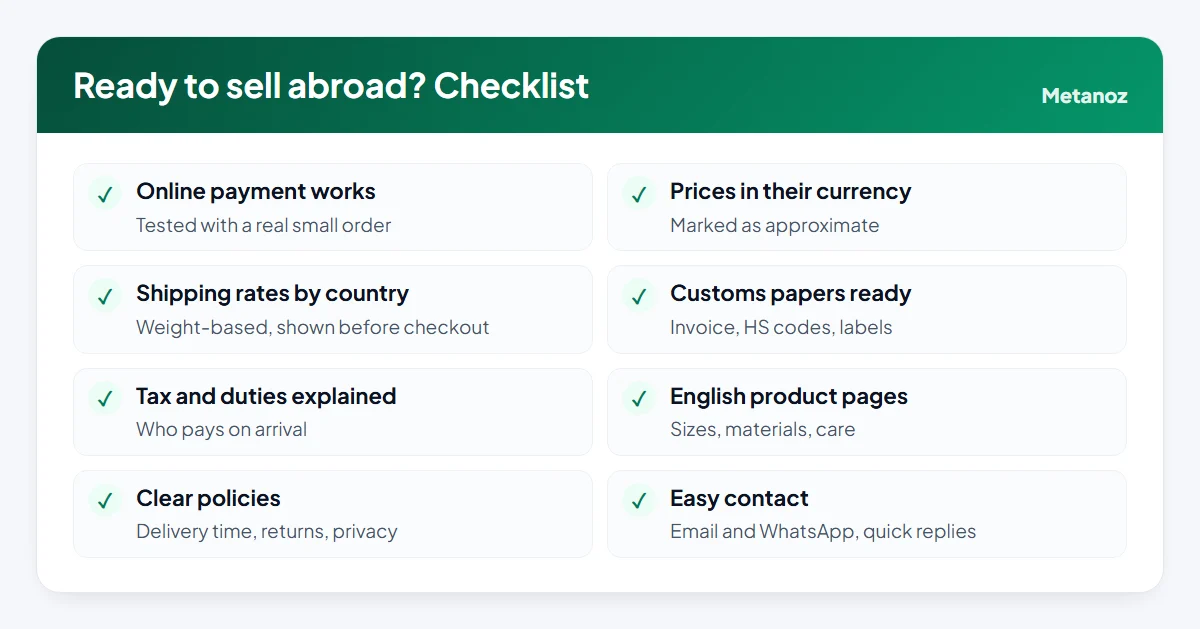
To sell abroad from Bangladesh you need five things that local selling does not: online payment by card or PayPal (there is no cash on delivery across borders), prices buyers understand in their own currency, international shipping with rates by country and proper customs papers, a clear answer on tax and import duties, and product pages in the buyer's language with policies that build trust. Start with one or two countries and a small range of products that travel well, test a few real orders, then grow.
Many Bangladeshi brands get their first foreign orders by accident: a relative in London shares a post, or a buyer in Dubai messages on WhatsApp. Turning those one-off orders into a steady business is a different job from selling inside Bangladesh. Customers cannot pay by bKash or on delivery, parcels cross customs, and every question about size, price or delivery has to be answered before the buyer trusts a shop they have never visited.
This guide covers payments, currency, shipping, tax, language and trust in the order you will meet them. Where rules or fees are involved, we explain how things work and who to confirm with.
Written in October 2026. This is general information, not legal, tax or financial advice. Banking, export and tax rules change; confirm with your bank, the relevant authority and each provider.
In this article
Who buys from Bangladesh online
Know who your foreign buyers are first; it shapes every other decision.
- Bangladeshis living abroad. Often the first and most loyal group: they want familiar clothes for Eid and weddings, books, food items that are allowed to travel, and gifts. They read Bangla and English, and often ask for delivery to family in Bangladesh too.
- Buyers of handmade and heritage products. Jamdani and other handloom textiles, nakshi kantha, leather goods, jute, pottery and crafts appeal to people who value handmade work and a story behind it.
- Business buyers. Small shops and boutiques abroad that want to buy in larger quantities. These usually need quotes, samples and bank transfers more than a shopping cart.
Products that travel well are light, not fragile, not perishable and not restricted. Food, cosmetics, batteries, liquids and anything with animal or plant material may face extra rules in the destination country. Check before you list them for international delivery.
Payments from abroad
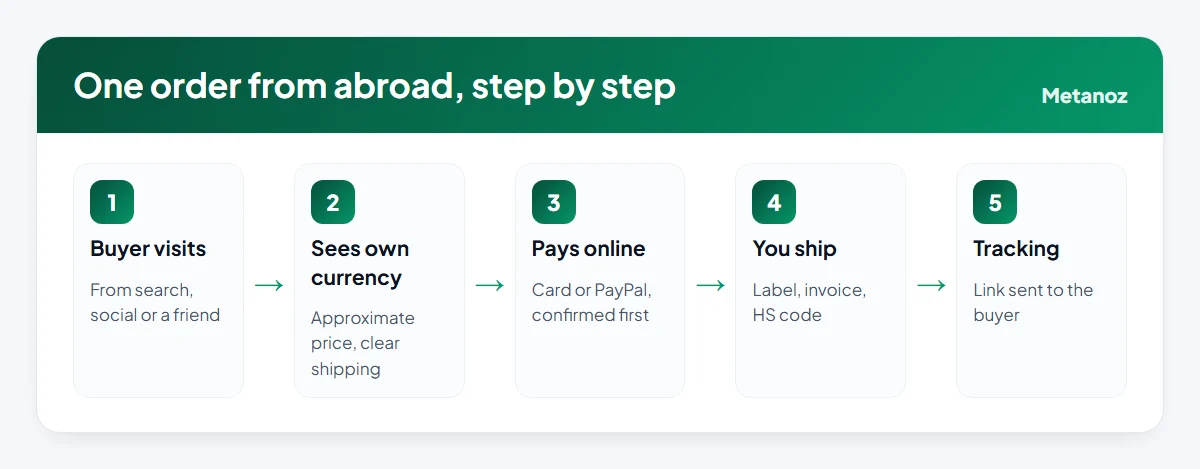
This is usually the hardest part, so solve it first. Buyers abroad expect to pay online by card or PayPal before you ship; cash on delivery does not work across borders, and bank transfers rarely work for small orders.
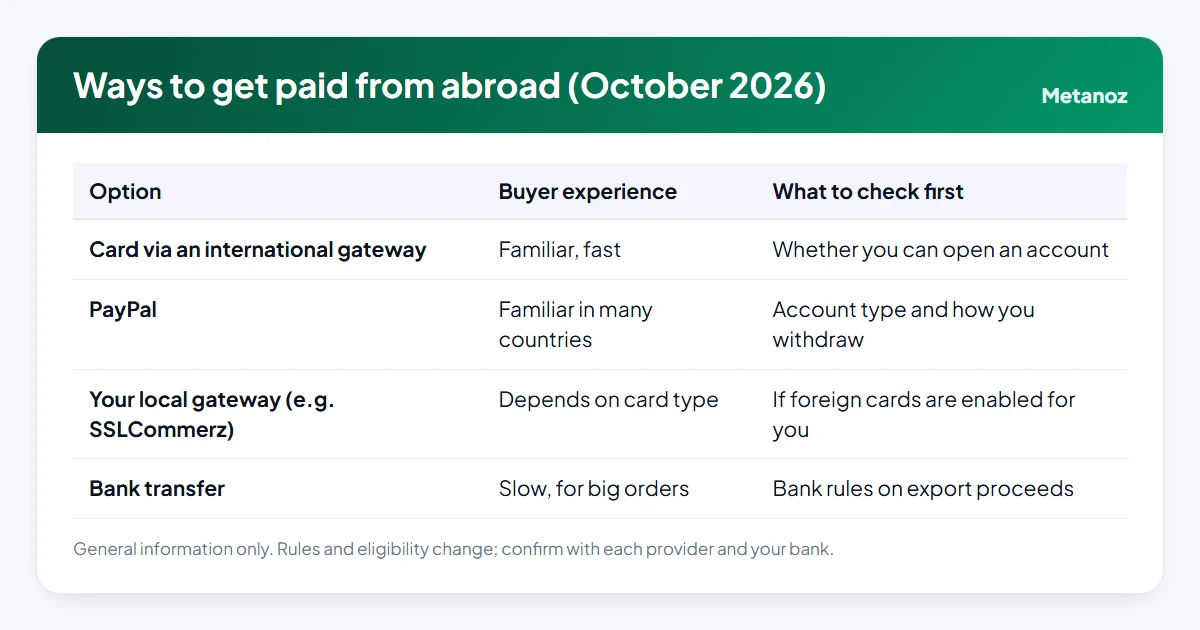
- International card gateways and PayPal. These are what most foreign buyers know. Each provider decides which countries and business types it accepts, and how you can receive or withdraw money. For a Bangladeshi business, opening and using such accounts is often the real obstacle, so check eligibility and withdrawal options with the provider before you build anything. We look at this in detail in Stripe and PayPal in Bangladesh: what works and what does not.
- Your local gateway. A Bangladeshi gateway such as SSLCommerz is built mainly for local payments. Whether foreign-issued cards can pay through your merchant account depends on your agreement; ask them directly.
- Bank transfer. Practical for larger business orders. Your bank will explain the paperwork for receiving payment for exports.
Do not skip the bank conversation. Money for goods sold abroad is foreign exchange, and Bangladesh has rules on how export proceeds are received and reported. Talk to your bank before your first foreign sale so that payments are received through the right channel and you have the records you need.
For a fuller picture of the local options, see our comparison of payment gateways in Bangladesh.
Prices in other currencies
A buyer in Toronto who sees "৳6,500" has to stop and work out what it means. Many will simply leave. Showing an approximate price in their own currency removes that friction.
- Show approximate prices, charge one currency. A common approach is to show an approximate local price for comfort and make it clear which currency the payment is actually charged in. The buyer's bank or PayPal may add its own conversion fee.
- Update rates regularly. Exchange rates move. Prices that were set by hand months ago can quietly cost you money.
- Price for the foreign market, not just converted. International orders cost more to serve: packaging, payment fees, paperwork and your time answering questions. Many sellers set separate international prices instead of simply converting the local price.
Shipping abroad
You have two broad options. International express couriers are faster, give good tracking and handle much of the customs process, but cost more. Postal services such as EMS through Bangladesh Post are usually cheaper but slower, with tracking that varies by destination.
- Weigh and measure your typical parcel. Shipping is charged by weight and often by size (volumetric weight). A saree in a slim box costs far less than the same saree in a large gift box.
- Get rates for your main countries. Ask two or three carriers for rates to the countries you expect most orders from, then set shipping charges by country and weight on your website, so buyers see the full cost before they pay.
- Prepare customs papers. Each parcel needs a commercial invoice describing the goods honestly, their value, and an HS code (the international product classification number). Wrong or vague descriptions are a common cause of delays.
- Send tracking links. International buyers wait longer, so send the tracking link the day you ship and an update if anything changes.
- Decide what happens if a parcel is returned. International returns are expensive. Say clearly in your policy which cases you accept and who pays.
Tax, VAT and import duties
There are two sides to think about. At home, your sales are business income and may have VAT and income tax implications in Bangladesh; an accountant can tell you what applies to your type and size of business. Abroad, the buyer's country may charge import duty and VAT when the parcel arrives, depending on the value and type of goods.
The most important thing for buyer trust is to say who pays those charges. If the buyer has to pay duty on delivery and did not expect it, you may get a refused parcel and an angry review. A short line on every product page, such as "Import duties and taxes in your country, if any, are paid by the buyer on delivery", prevents most of these surprises.
If you plan to sell to buyers in Europe or the UK, also look at data protection: a privacy policy that explains what you collect and why, and a way for customers to ask for their data to be deleted.
Language
English product pages are the minimum for most foreign buyers, and Bangla stays useful for the diaspora. If you target a specific market, such as Arabic-speaking buyers in the Gulf, consider key pages in that language too.
- Write the important pages yourself. Product names, sizes, materials, care instructions, shipping and returns are where automatic translation makes costly mistakes. Write or check these in English yourself.
- Use international units. Give sizes in centimetres as well as inches, and avoid local terms like "gaj" without an explanation.
- Explain what is familiar to you. A buyer abroad may not know what a three-piece, a panjabi or a jamdani is. One sentence of explanation turns confusion into interest.
Trust signals
A buyer abroad pays before seeing anything, so your website has to answer "Is this real, and will I get my order?"
- Your own domain and https, not just a social media page.
- An About page with your story, your workshop or weavers, and a physical address in Bangladesh.
- Clear delivery times by country, written honestly rather than optimistically.
- Return, refund and privacy policies that are easy to find.
- Reviews from real buyers, added only with their permission. Never invent them.
- Fast replies by email and WhatsApp, keeping in mind the time difference.
Setting this up on your website
If you already sell in Bangladesh, the simplest path is usually one website that serves both local and foreign buyers: bKash, Nagad and cash on delivery for Bangladesh, card and PayPal for everyone else. Our step-by-step guide to building an e-commerce website in Bangladesh covers the basics.
On Metanoz, the Sell worldwide apps are available from the Business plan (contact us for pricing): International Payments (buyers pay by card through Stripe or by PayPal straight into your own account, and an order is marked Paid only after the gateway confirms it), Multi-Currency (approximate prices in the buyer's currency, with rates updated daily), International Shipping (rates by country, HS codes and weights, printable labels and commercial invoices, tracking links), Languages & Translation, Tax & VAT, and Privacy & GDPR. You can see them together on the Sell worldwide features page and in the apps list.
Where Metanoz is not the right fit: Metanoz cannot open a Stripe or PayPal account for you; you need your own, and eligibility is decided by those companies. If most of your customers are abroad and you need a very large international app ecosystem, a global platform such as Shopify may suit you better. Metanoz is strongest when Bangladesh is still a big part of your sales.
Where to start
Pick one or two countries where you already have interest, often where your relatives or past buyers live. Sort out how you will get paid and talk to your bank, get shipping rates for those countries, and rewrite your ten best product pages in clear English with sizes in centimetres. Then run a few real orders end to end before spending on advertising. If you are still at the very beginning, read how to start an online business in Bangladesh first.
Start your website today
Pick a template and a name; Metanoz sets up the rest. 7 days free, no card needed.
Start freeSee templatesFrequently asked questions
Can I accept PayPal or Stripe payments in Bangladesh?
It depends on what those companies allow for your country and business at the time you apply, and on how you can withdraw the money. Check their current eligibility rules directly before building your checkout around them.
Can I offer cash on delivery to buyers abroad?
In practice, no. International carriers generally do not collect cash for small sellers, and the risk of refused parcels is high. Buyers abroad expect to pay online before shipping.
Who pays import duty when I ship abroad?
Usually the buyer pays any import duty and taxes in their country when the parcel arrives, unless you choose to include them. Whatever you decide, state it clearly on your product and checkout pages.
Do I need an export licence to sell online to foreign buyers?
Requirements depend on what you sell, how much and how you receive payment. Small parcel sales and larger commercial exports can be treated differently. Ask your bank and the relevant authority; this guide is general information, not legal advice.
Which products are easiest to sell abroad from Bangladesh?
Light, durable, non-perishable products with a clear story travel best: handloom textiles, clothing, leather goods, jute and handicrafts. Food, cosmetics, liquids and batteries often face extra rules in the destination country.
 অনলাইন ব্যবসা শুরু করার নিয়ম: শূন্য থেকে প্রথম অর্ডার পর্যন্ত (২০২৬)
 How to Build an E-commerce Website in Bangladesh (Step by Step)
 অনলাইনে পোশাকের ব্যবসা শুরু: সোর্সিং থেকে সাইজ চার্ট পর্যন্ত