


There is no single best ecommerce platform in Bangladesh; there is a best fit for where your customers are and how they pay. If most buyers are abroad and pay by card, a global platform such as Shopify is the strongest option. If you want full control at the lowest cash cost and can maintain it yourself, WordPress with WooCommerce works. If most buyers are in Bangladesh and pay by cash on delivery, bKash or Nagad, a local hosted builder with those payments, local couriers and taka pricing built in is usually the least work. A custom build only makes sense for unusual needs and a larger budget.
Search for "best e-commerce platform in Bangladesh" and you will find lists that rank tools without saying who they are best for. That is not very helpful, because a clothing brand shipping to the UK and a home cook selling pickles in Mirpur need different things. This guide sorts the options into four kinds, explains what matters specifically for selling in Bangladesh, and gives an honest view of who each kind suits.
We make Metanoz, a local hosted builder, so we have an interest in this topic. We have tried to be fair about where other options are stronger, avoided numbers we cannot verify, and dated everything. This guide reflects what we could check in October 2026. Platforms change quickly, so confirm prices, payment options and features on each provider's own pages before you decide.
In this article
The four kinds of e-commerce platform
Almost every option a Bangladeshi seller considers falls into one of four groups. Understanding the group tells you most of what you need to know about cost, effort and limits before you look at any individual product.
1. Global hosted platforms (Shopify, Wix and similar)
You pay a monthly subscription and the platform handles hosting, security and updates. Shopify is built around e-commerce and has the largest app ecosystem; Wix is known for its flexible visual editor and also sells online. Both are mature, reliable and well documented. For a Bangladeshi seller, the main points to check are that subscriptions are usually priced in US dollars and paid by international card, that cash on delivery and bKash or Nagad generally work as manual payment methods or through third-party add-ons, and that local courier connections depend on third-party apps. Our detailed comparison of Wix, Shopify and Metanoz goes through these one by one.
2. WordPress with WooCommerce
WordPress is free, open-source software; WooCommerce is a free plugin that turns it into a shop. You rent hosting (local hosting can be paid in taka), install a theme and add plugins for payments, couriers, SMS and so on. It offers almost unlimited freedom, and many Bangladeshi developers know it well. The trade-off is responsibility: updates, security, backups, plugin conflicts and speed are yours to manage, or a developer's to manage for a fee. We compare the two approaches in WooCommerce or a hosted online store.
3. Local hosted builders
Several Bangladeshi companies now offer hosted store builders designed for the local market. They work like Shopify or Wix (monthly plan, hosting included, no coding) but are typically priced in taka, payable by bKash or Nagad, with cash on delivery, mobile wallets and local couriers built in, and often a Bangla admin. Metanoz is one of them. Builders in this group differ a lot in templates, features, how long they have existed and how they support you, so compare at least two on a free trial.
4. Custom-built stores
An agency or freelancer builds the store for you, either from scratch or on a framework. You get exactly what you specify, and you pay for it: typically a significant one-time cost plus hosting and ongoing maintenance. This route makes sense for unusual business logic (complex wholesale pricing, deep ERP integration, a multi-vendor marketplace with custom rules) when off-the-shelf tools genuinely cannot do the job.
What about Daraz or Facebook? Marketplaces and Facebook shops are sales channels rather than store platforms. They are excellent for reach, and many sellers keep using them alongside their own site. But you do not own the customer relationship or the page design there. Most growing sellers end up with both: marketplace and social media for discovery, their own store for repeat customers.
What matters when selling in Bangladesh
Feature lists look similar across platforms. These are the questions that separate them for a Bangladeshi business:
- How customers pay. Cash on delivery is still common, and bKash and Nagad are everyday payment methods. Check whether the platform supports them natively, through a plugin, or only as "manual payment" text. For automatic card and wallet payments you need a gateway account such as SSLCommerz; its fees and paperwork are set by the gateway, so confirm them directly. Our guide to payment gateways in Bangladesh explains the options.
- How parcels get delivered. Delivery charges inside and outside Dhaka, and whether you can send orders to your courier without retyping addresses, save real time once orders grow.
- How you pay the platform. A dollar subscription needs an international card and changes with the exchange rate. Taka pricing by bKash or Nagad is simpler for many small businesses.
- Language. Nearly all platforms can show Bangla on the storefront. Fewer offer the admin itself in Bangla, which matters if the person packing orders is more comfortable in Bangla.
- Speed on mobile data. Most shoppers arrive on a phone, often from a Facebook link. Test the demo store on your own phone using mobile data, not office Wi-Fi.
- Fake and incomplete orders. Order confirmation by phone or SMS, and a way to follow up on abandoned checkouts, matter more in a cash-on-delivery market.
- Who fixes things. If something breaks on a Friday evening before Eid, who do you contact, in which language, and how quickly do they reply?
- Your exit. Register your domain in your own name, and check that you can export products, customers and orders. That keeps your options open whichever platform you choose.
Comparison table
This table summarises general patterns for each kind of platform. Individual products vary, so treat it as a starting shortlist, not a verdict.
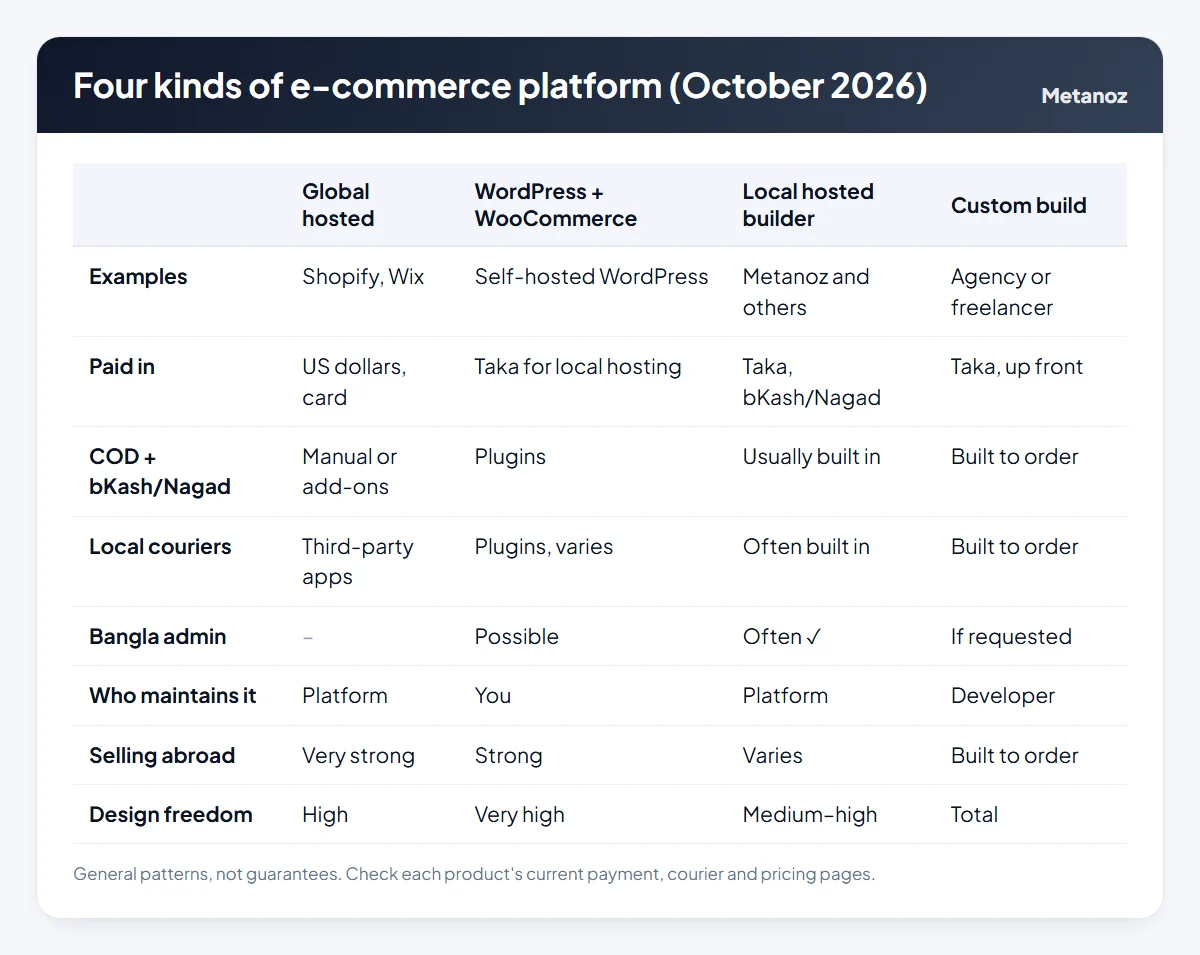
Cost is hard to put in one table because the structures differ. As a rough guide for a small store, as of October 2026: a global platform costs a monthly dollar subscription plus any paid apps and, in some cases, extra transaction fees; WordPress with WooCommerce costs approximately ৳8,000–15,000 in the first year for domain, local hosting and a premium theme, plus your own time; a local builder costs a monthly taka plan (on Metanoz, the online store is in the Business plan; contact us for pricing); and a custom build typically starts in the tens of thousands of taka and rises quickly with features. Whatever you consider, add up two years of cost including apps, fees, maintenance and your domain. Our website cost breakdown for Bangladesh has a worked example.
Who each one suits
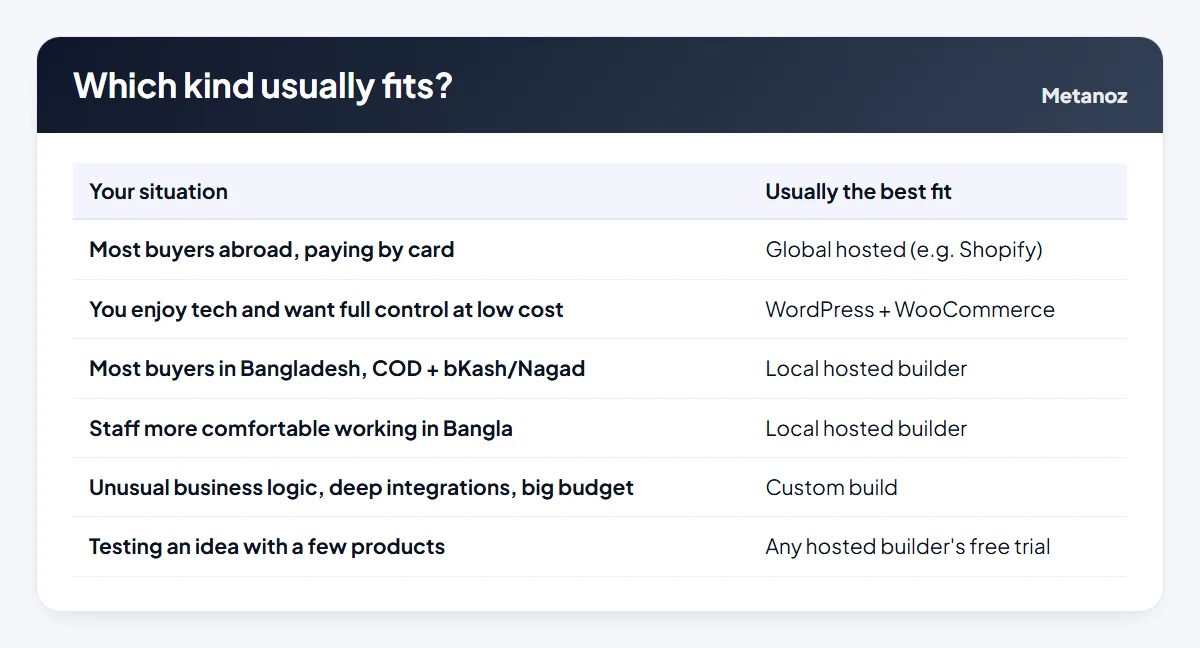
Choose a global hosted platform if…
Most of your buyers are outside Bangladesh and pay by card, you need a specific integration that only a large app ecosystem offers, or you plan to run stores in several countries. Shopify in particular is very hard to beat for international e-commerce depth.
Choose WordPress with WooCommerce if…
You or someone on your team is comfortable with hosting, updates and plugins, you want maximum control, and you want the lowest cash cost. It also suits businesses whose main asset is content, such as a blog with a shop attached. Budget time every month for maintenance.
Choose a local hosted builder if…
Most buyers are in Bangladesh, you rely on cash on delivery and mobile wallets, you want couriers and area-based delivery charges handled for you, and you would rather spend your time on products and marketing than on servers. Also a good choice if your staff prefer working in Bangla.
Choose a custom build if…
Your business process truly does not fit any platform, you have the budget for development and maintenance, and you have a reliable technical partner with a written contract. Many businesses that start here later move to a platform once they see the maintenance cost.
How to test before you commit
A week of real testing tells you more than any comparison article, including this one.
- Shortlist two platforms from different groups, for example one global and one local, and start free trials.
- Add the same five real products with prices, photos, variants (size, colour) and stock.
- Set up delivery charges for inside and outside Dhaka, and your actual payment methods.
- Place test orders on your phone with cash on delivery and with the wallet most of your customers use.
- Process each order as you would for real: confirm, book the courier, mark as delivered.
- Ask support one real question and note how quickly and clearly they answer.
How to switch platforms later
Choosing a platform is not a life sentence, but switching does take work. Plan for it from day one:
- Own your domain. Buy it from a registrar in your own name, never in a developer's or agency's name. Then you can point it to any platform.
- Keep your content portable. Keep original product photos and descriptions in a folder or spreadsheet, not only inside the platform.
- Export regularly. Products, customers and orders can usually be exported as CSV files. Check this during your trial.
- Expect to redo the design. Themes and page designs do not move between platforms; your content does.
- Protect your Google rankings. When you move, keep page addresses the same where possible, or set up redirects from old addresses to new ones, and resubmit your sitemap in Google Search Console.
If you are still deciding between running WordPress yourself and using a builder, read WordPress vs a website builder in Bangladesh. If Shopify or Wix specifically is on your shortlist, see our guides to Shopify alternatives and Wix alternatives for Bangladesh.
Where Metanoz fits
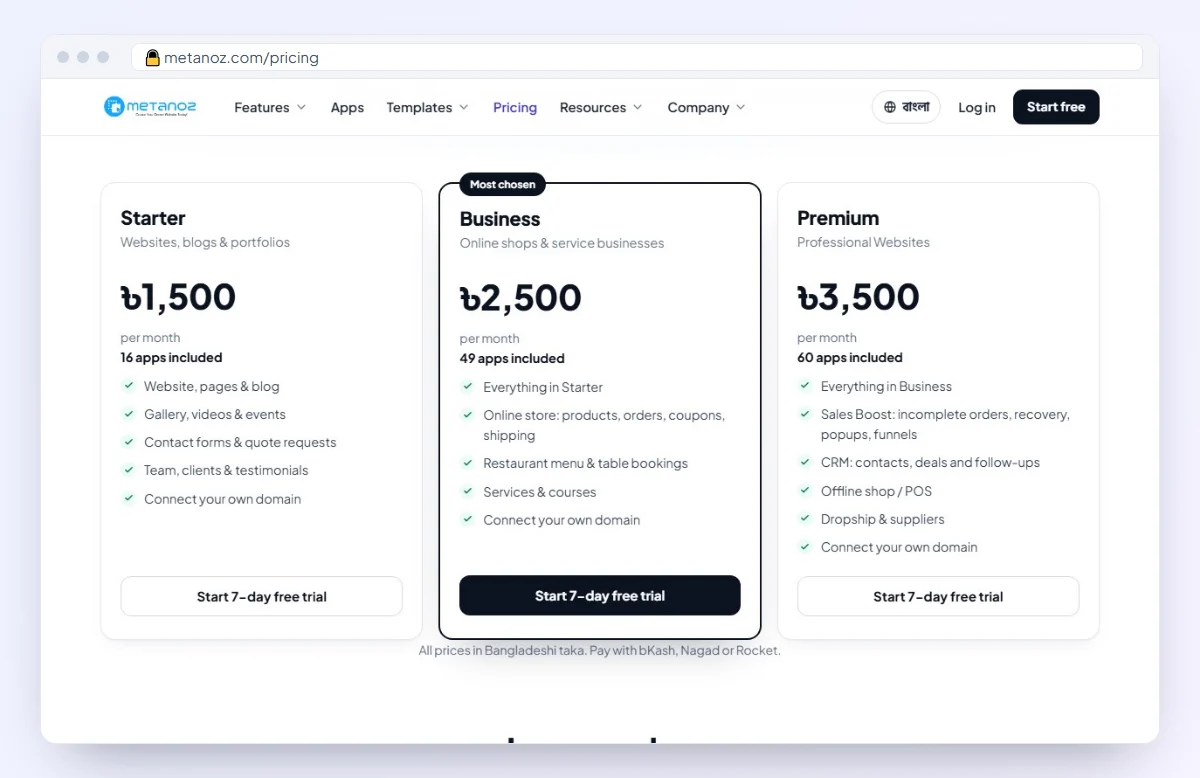
Metanoz is a local hosted builder made for businesses in Bangladesh. The online store comes with the Business plan (contact us for pricing); the Premium plan adds Sales Boost (incomplete orders, recovery, popups, funnels), CRM, an offline shop/POS and dropshipping. Plans are paid month by month by bKash, Nagad or Rocket, with a 7-day free trial and no card needed.
- Payments: cash on delivery; bKash and Nagad to your own number, with no commission taken by Metanoz; your own SSLCommerz account for cards, wallets and bank payments, verified server to server; and an International Payments app that takes Stripe and PayPal payments from buyers abroad into your own accounts (whether you can open those accounts depends on Stripe's and PayPal's country rules).
- Delivery: delivery charges by area, and orders sent to Pathao or Steadfast from the admin.
- Design: more than 320 templates across 10 kinds of business (58 of them for online stores in October 2026), a drag-and-drop builder with more than 180 section designs, and an AI page maker.
- Language and support: Bangla and English storefronts, a Bangla admin with English one click away, and a Help Center in both languages.
Where it is not the best fit: if most of your sales are international card payments, if you need a niche integration that exists only in a large global app store, or if you want to run and modify the software yourself, a global platform or WooCommerce will serve you better. You can compare features on the features page, plan details on the pricing page, and browse store designs on the online store templates page.
Start your website today
Pick a template and a name; Metanoz sets up the rest. 7 days free, no card needed.
Start freeSee templatesFrequently asked questions
What is the best e-commerce platform in Bangladesh for a small business?
It depends on where your customers are and how they pay. For a small business selling mainly inside Bangladesh with cash on delivery and bKash or Nagad, a local hosted builder is usually the least work. For mainly international card sales, a global platform such as Shopify is usually stronger.
Can I use Shopify in Bangladesh?
Yes, you can run a Shopify store from Bangladesh. Check how you will accept cash on delivery, bKash and Nagad, which card gateway you will use, how parcels will be booked with local couriers, and the total cost in US dollars including apps and any transaction fees.
Is WooCommerce cheaper than a website builder?
In cash terms it is often cheaper, at approximately ৳8,000–15,000 for the first year of a small store as of October 2026. But updates, security, backups and plugin problems are your responsibility, so count the value of your time or a developer's fees.
Do I need a trade licence to open an online store?
You can build a store and take bKash or Nagad payments to your own number without one on most builders, but a payment gateway, merchant account or business bank account will ask for a trade licence. This is general information, not legal advice; rules change, so check with the relevant office.
Can I move my store to another platform later?
Yes, if your domain is registered in your name and you export your products, customers and orders. The design does not transfer, and you should set up redirects to keep your Google rankings.
Which platform supports Pathao and Steadfast?
Support varies by platform and changes over time. On global platforms and WooCommerce it usually depends on third-party apps or plugins. Metanoz has Pathao and Steadfast built in. Check each platform's current courier options during your trial.
Why should I trust a comparison written by Metanoz?
You should verify it. We have dated it, said where other platforms are stronger, and avoided claims you cannot check. If something has changed, tell us through the contact page and we will update the guide.
 Wix vs Shopify vs Metanoz: Which Works Best for a Business in Bangladesh? (October 2026)
 বাংলাদেশে ওয়েবসাইট বিল্ডার তুলনা (অক্টোবর ২০২৬): কোনটা কার জন্য
 ওয়ার্ডপ্রেস নাকি ওয়েবসাইট বিল্ডার: বাংলাদেশের ব্যবসার জন্য সৎ তুলনা