


Shopify is excellent, especially for selling abroad, but local selling in Bangladesh runs on cash on delivery, bKash, Nagad and local couriers, which Shopify only covers through manual methods or third-party apps, with plans billed in US dollars. The realistic Shopify alternatives for Bangladesh are WooCommerce (most control, you run it), Wix (design-led sites), a custom build (unusual needs) and local builders such as Metanoz (bKash, Nagad, COD, couriers and a Bangla admin built in). Pick by where your buyers are and how they pay.
Many Bangladeshi sellers look at Shopify first, and for good reason: it is one of the most capable e-commerce platforms in the world. The question is not whether Shopify is good, but whether it fits how your customers actually pay and receive parcels. This guide explains what Shopify does well, where the gaps are for local selling, and the alternatives worth considering, with honest notes on where each one is weaker.
We make Metanoz, one of the alternatives listed, so we have an interest here. We have tried to keep claims checkable and dated this article October 2026. Platforms change quickly; check each provider's current pricing, payment and app pages before you decide.
In this article
What Shopify does well
It is worth being clear about Shopify's strengths, because they are real:
- Mature e-commerce tools. Product variants, inventory, discounts, abandoned checkouts, reports and a polished admin, refined over many years.
- A very large app ecosystem. If you need a niche feature or an integration with a global service, someone has probably built a Shopify app for it.
- Selling internationally. Multi-currency, international shipping, tax tools and well-designed themes for overseas buyers.
- Reliability and scale. Hosting, security and updates are handled for you, and it scales to very large stores.
If most of your buyers are abroad and pay by card, Shopify may well be the right choice, and you may not need an alternative at all. Our Wix vs Shopify vs Metanoz comparison goes deeper into that decision.
Gaps for local selling
The gaps appear when most of your customers are in Bangladesh:
- Payments. Shopify's own payment service is not available to businesses in Bangladesh, so you use manual payment methods (for example "pay by bKash, then send us the TrxID") or third-party gateway apps. Shopify also charges an additional transaction fee when a third-party payment provider is used. Check the current fee on Shopify's pricing page.
- Cash on delivery. Supported as a manual payment method, but the work of confirming orders, chasing fake orders and settling courier cash is outside Shopify.
- Couriers. Booking parcels with Bangladeshi couriers depends on third-party apps; check whether one exists for your courier and how actively it is maintained.
- Delivery charges. Shipping zones are built around countries and regions; "inside Dhaka / outside Dhaka" pricing usually takes some setting up.
- Billing. Plans and most apps are billed in US dollars by international card, which not every small business has, and the cost moves with the exchange rate.
- Language. The storefront can show Bangla, but as far as we know the admin is not available in Bangla as of October 2026.
None of these makes Shopify unusable in Bangladesh. They add work, cost or app dependencies, and the alternatives below solve them in different ways.
Alternatives
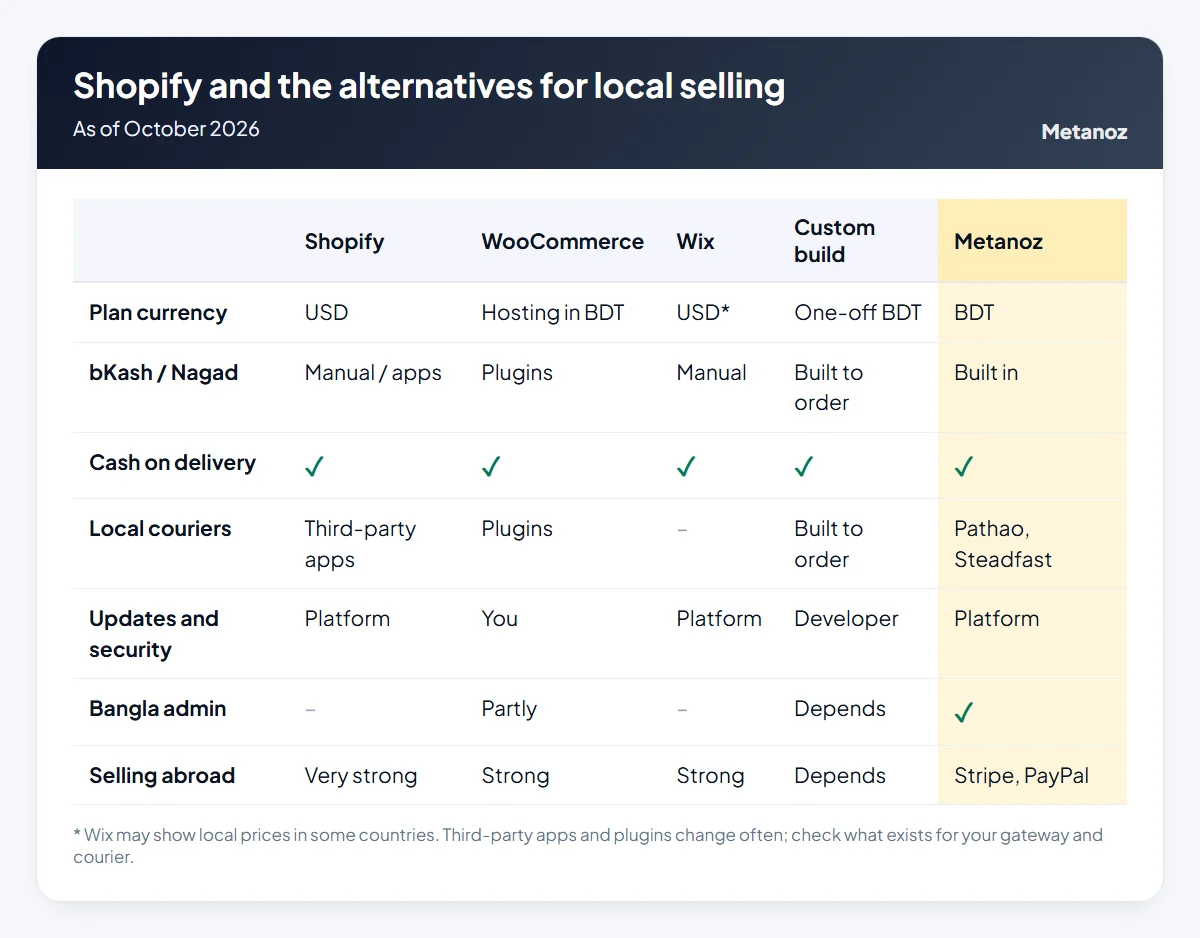
1. WooCommerce (WordPress)
WooCommerce is a free plugin that turns a WordPress site into a store. You buy a domain and hosting (local hosting can be paid in taka), install WordPress and WooCommerce, and add plugins for payments and couriers. Plugins exist for SSLCommerz and some local wallets and couriers, made by the providers themselves or third parties.
Strengths
- Full control and ownership of files and data
- Huge plugin ecosystem and many local developers
- Low cash cost if you run it yourself
Watch out for
- Updates, security, backups and hosting are your job
- Plugin quality varies; conflicts happen
- Slow on cheap hosting as the store grows
Best for sellers who are comfortable with technology or have a reliable developer. See WordPress vs a website builder in Bangladesh for a two-year cost comparison.
2. Wix
Wix is a hosted builder with one of the most flexible visual editors available and a large template library. Its online store features are solid for small catalogues. For local selling it has the same broad pattern as Shopify: manual payment methods for COD and wallets, card gateways where supported, plans priced mainly in US dollars, and few local courier options. Best for design-led brand sites where local wallet payments are less central.
3. A custom-built store
A developer or agency builds the store to your exact requirements, often with bKash, SSLCommerz and courier integrations made to order. This makes sense for unusual workflows that no platform covers, or for large businesses with their own systems. The trade-offs are a higher upfront cost, a longer build, and dependence on the developer for changes and security. Get a written agreement covering ownership, hosting, maintenance and who holds the domain.
4. Facebook page with inbox orders
Many Bangladeshi businesses start here, and it is a perfectly sensible way to test demand. There is no platform fee and customers are already on Facebook. The limits show as orders grow: answering the same questions in the inbox, copying addresses by hand, no checkout, and the risk of reach dropping or a page being restricted. Most growing sellers keep the page and add a website that takes the orders.
5. Local builders, including Metanoz
Builders made for Bangladesh price plans in taka and build local payments and couriers into the platform. As one example, here is what Metanoz includes (October 2026):
- bKash and Nagad (customer pays your number and enters the TrxID; Metanoz takes no commission), cash on delivery, and your own SSLCommerz merchant account for card, wallet and bank payments, verified server to server before an order is marked paid.
- Delivery charges by area, and parcels sent to Pathao and Steadfast from the admin.
- A Bangla admin with English one click away, and plans paid monthly by bKash, Nagad or Rocket: Starter, Business (online store starts here) and Premium; contact us for pricing. See the pricing page.
- 60 built-in apps switched on as needed, including an International Payments app that takes Stripe and PayPal payments from buyers abroad into your own accounts (if Stripe's and PayPal's country rules let your business open them).
Where Metanoz is weaker than Shopify: a much smaller third-party ecosystem, fewer years of refinement, and less depth for large international operations. If you need a niche global integration, Shopify is more likely to have it.
Comparison table
The table above summarises payments and responsibilities. The questions below add the practical detail that usually decides it:
| Question | Shopify | WooCommerce | Local builder (e.g. Metanoz) |
|---|---|---|---|
| Who handles hosting and security? | Shopify | You or your developer | The platform |
| How do you pay for it? | USD, international card | Hosting and plugins, often BDT and USD | BDT, bKash/Nagad/Rocket |
| Commission on bKash/Nagad orders? | Extra fee may apply with third-party providers; check | Depends on the plugin and gateway | None from Metanoz |
| Courier booking from admin? | Via third-party apps, if available | Via plugins, if available | Pathao, Steadfast |
| Integrations with global tools | Very large choice | Very large choice | Smaller; API and webhooks |
| Time to launch | Days | Days to weeks | Hours to days |
Gateway and courier charges are set by each provider under your agreement with them, so confirm current rates directly. For a wider look at every option, read best e-commerce platforms for Bangladesh.
Choosing
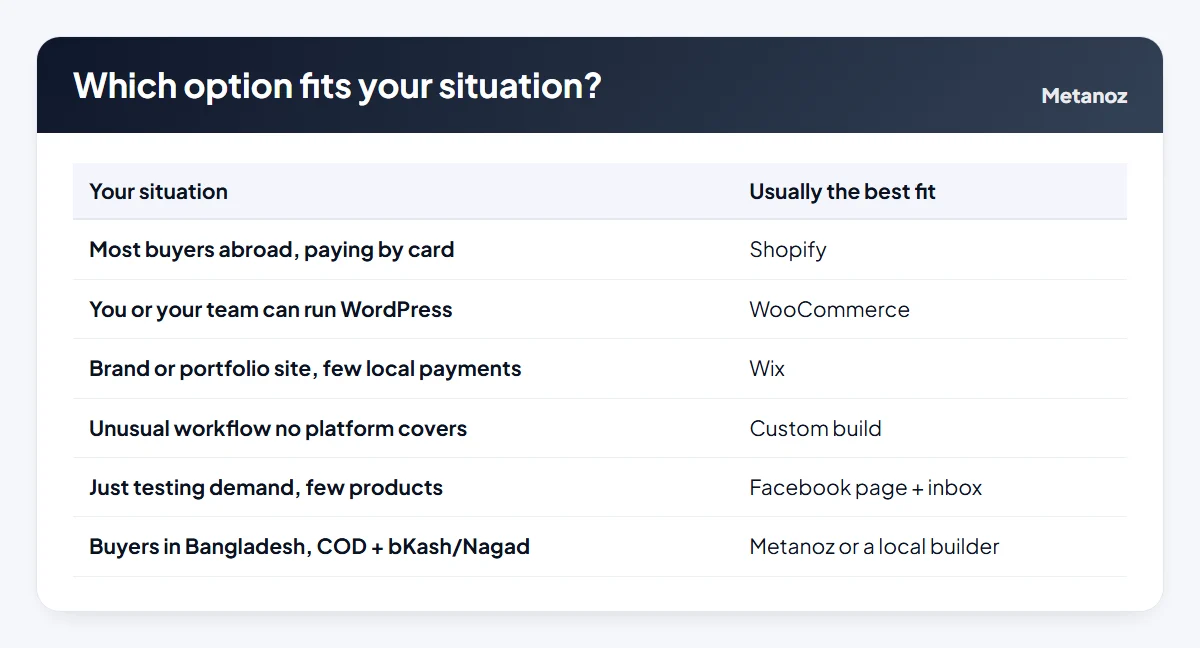
- Write down where your buyers are and how they pay. If most pay by card from abroad, start with Shopify. If most pay cash on delivery or by bKash and Nagad, weight local payment support heavily.
- Decide who will run the technical side. If nobody on your team will handle updates and backups, avoid self-hosted options or budget for a developer.
- Shortlist two platforms and start free trials. Most hosted platforms offer one; Metanoz gives 7 days with no card.
- Build the same five products on both, with real prices, photos and delivery charges for inside and outside Dhaka.
- Place a test order on your phone using the payment method most of your customers use, then try booking the parcel.
- Add up two years of cost: plan, apps or plugins, gateway fees, domain and any developer time.
Keep your options open: buy your domain in your own name from any registrar and connect it to the platform. If you switch later, your address and the links you have shared keep working.
What to do next
If you sell mainly to customers abroad, Shopify remains a strong default. If your buyers are in Bangladesh and pay cash on delivery or by mobile wallet, try a builder designed for that alongside your other shortlisted option and compare them with your own products. You can browse online store templates and start a trial in a few minutes.
Start your website today
Pick a template and a name; Metanoz sets up the rest. 7 days free, no card needed.
Start freeSee templatesFrequently asked questions
Can I use Shopify in Bangladesh?
Yes. You can run a Shopify store from Bangladesh. Plan how you will accept cash on delivery and bKash or Nagad (manual methods or third-party apps), which card gateway you will use, how parcels will be booked, and the total cost in US dollars including any extra transaction fees.
What is the cheapest Shopify alternative in Bangladesh?
In cash terms, a self-run WooCommerce store is usually cheapest, but you take on updates, security and backups. A local builder costs a fixed monthly amount in taka with those handled for you. Compare two-year totals, including your own time.
Does Shopify support bKash?
Not natively as of October 2026. You can add bKash as a manual payment method with instructions, or use a third-party app or gateway where one is available. Check Shopify's current payment settings and app store.
Is WooCommerce better than Shopify for Bangladesh?
It is more flexible for local payments and couriers through plugins, and cheaper in cash, but you run it yourself. Shopify is easier to run and stronger internationally. The better choice depends on your technical capacity and where your buyers are.
Can I move from Shopify to another platform later?
Yes. Products and customers can usually be exported and imported, and your domain moves if it is registered in your name. Themes and designs do not transfer, so plan time to rebuild the look.
Why should I trust a comparison written by Metanoz?
You should check it. We have dated it, listed where Shopify and others are stronger, and avoided figures we cannot verify. If something has changed, tell us through the contact page and we will update it.
 Wix vs Shopify vs Metanoz: Which Works Best for a Business in Bangladesh? (October 2026)
 বাংলাদেশে ওয়েবসাইট বিল্ডার তুলনা (অক্টোবর ২০২৬): কোনটা কার জন্য
 ওয়ার্ডপ্রেস নাকি ওয়েবসাইট বিল্ডার: বাংলাদেশের ব্যবসার জন্য সৎ তুলনা