


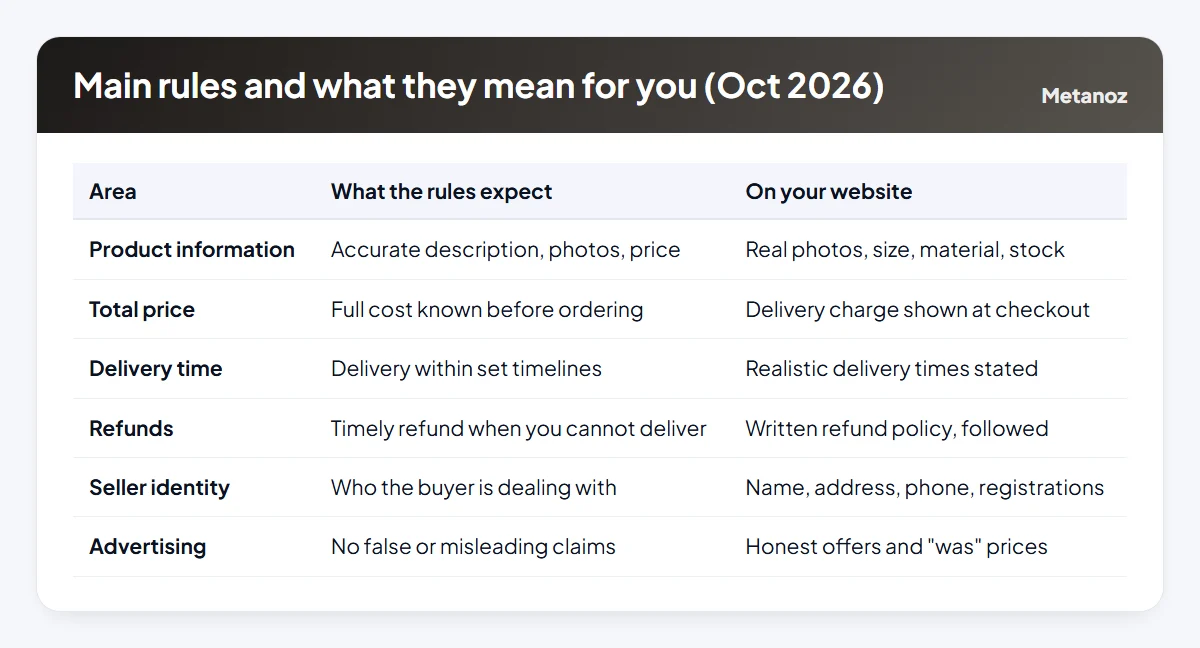
Online sellers in Bangladesh are covered by the Consumer Rights Protection Act 2009 and the Ministry of Commerce's Digital Commerce Operation Guidelines. In practice: show accurate product information and the full price (including delivery) before ordering, deliver within the timelines the guidelines set (as we understand them, generally 5 days within the same city and 10 days elsewhere), refund promptly when you cannot deliver, avoid misleading advertising, and show who you are. Most online sellers are also expected to hold a trade licence and a DBID, plus tax registrations where they apply. This is general information, not legal advice.
Many online businesses in Bangladesh start on Facebook with no paperwork at all, and grow quickly. Rules tend to come into view only when a customer complains, a payment partner asks for documents, or a courier or gateway requests a trade licence. Knowing the basics early saves trouble and also makes your business more trustworthy to customers. This guide summarises the main rules for online sellers in plain language and shows how to reflect them on your website.
General information, not legal or tax advice. Laws and guidelines are amended from time to time; check the current versions from the Ministry of Commerce, the Directorate of National Consumer Rights Protection and the relevant offices, and speak to a lawyer or tax adviser for your specific case. Information as we understand it in October 2026.
In this article
The main rules
Consumer Rights Protection Act 2009
This law applies to all sellers, online or offline. It treats a range of practices as offences against consumer rights, including misleading advertising, not supplying goods or services as promised, cheating on weight or measurement, and selling adulterated or expired products. The Directorate of National Consumer Rights Protection receives complaints, holds hearings and can impose fines.
Digital Commerce Operation Guidelines
Issued by the Ministry of Commerce after a period of high-profile e-commerce failures, the guidelines set specific expectations for online businesses: how products and prices are presented, delivery timelines, refunds, how advance payments are handled, and what information about the seller must be available. They have been revised before and may be again, so read the current version.
A Bangla version of this topic, with more detail on complaints, is in our guide to consumer rights for online sellers.
Product information and pricing
- Describe what you actually sell. Your own photos where possible; if colours vary slightly, say so. Include size, material, weight, expiry and warranty when they matter.
- Show the full cost. Product price plus delivery charge and any other fee, visible before the customer confirms the order.
- Be honest about discounts. Show a "was" price only if you genuinely sold at that price. Do not claim "only 2 left" or "limited stock" unless it is true.
- Avoid unprovable claims. "100% original", "cures", "guaranteed results" invite complaints when they cannot be backed up.
- Do not hide prices. Quoting different prices to different people in private messages damages trust and makes disputes harder to resolve.
Delivery timelines
The guidelines set maximum delivery times. As we understand them, delivery is generally expected within 5 days when buyer and seller are in the same city and within 10 days when they are in different cities or rural areas, with some exceptions for particular goods. Confirm the current figures before relying on them.
- State realistic times on product pages and at checkout, for inside and outside Dhaka, based on your courier's actual performance.
- Mark pre-orders clearly. If an item is not in stock or is made to order, say when it will ship before the customer pays.
- Tell customers about delays first. Eid rush, strikes or floods happen. Contact the buyer before they contact you, and offer a choice: wait or get a refund.
- Share tracking. Give the courier's tracking number or a way to check status.
Choosing and working with couriers is covered in our guide to courier services in Bangladesh.
Refunds
If you take payment in advance and cannot deliver, or if you accept a return under your policy, the money must go back to the customer within the time the guidelines set, as we understand it generally within 10 days, through the same channel the customer paid with. Your written refund policy should cover:
- When an item can be exchanged or refunded (wrong, damaged, or not as described).
- How many days the customer has to report a problem.
- Items that cannot be returned for hygiene or custom-made reasons, stated before purchase.
- Who pays return delivery in each case.
- How and how fast refunds are paid: bKash, Nagad, bank or gateway.
For cash on delivery orders, decide in advance whether customers may open the parcel before paying, write it in your policy, and tell your courier. Even with a "no opening" policy, if you sent the wrong item, the responsibility is yours.
Papers
Which documents you need depends on your structure (sole proprietor, partnership or company), what you sell and how much. These are the ones online sellers are most commonly asked for:
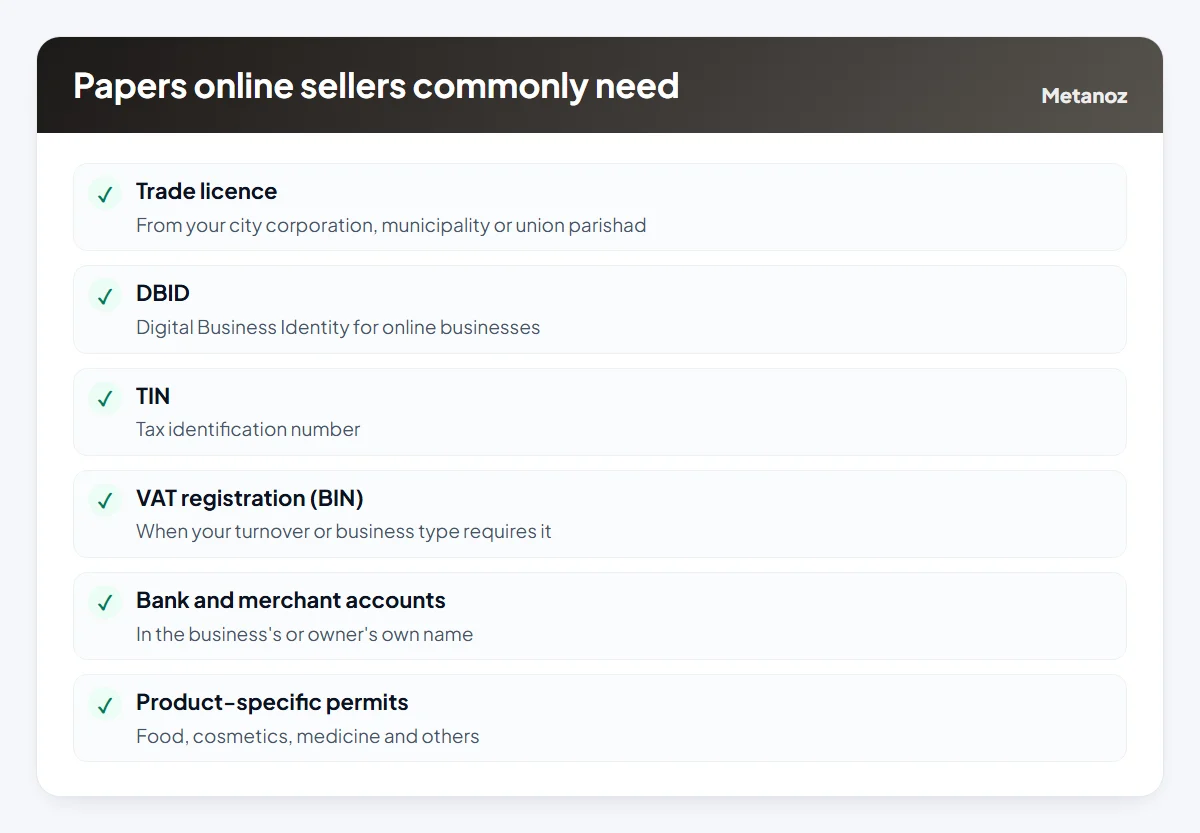
- Trade licence: from the city corporation, municipality (pourashava) or union parishad where your business is based. Our step-by-step trade licence guide for online businesses explains the process.
- DBID (Digital Business Identity): a registration the Ministry of Commerce introduced for online businesses. Payment gateways and marketplaces may ask for it.
- TIN and VAT registration: a TIN for tax; VAT registration (BIN) when your turnover or business type requires it. A tax adviser can tell you what applies.
- Product permits: food, cosmetics, medicine, electronics and some other categories may need approvals from specific authorities.
Our Bangla overview of the legal side of an online business lists the offices and documents in more detail.
Handling complaints
Customers can complain to the Directorate of National Consumer Rights Protection, which may call both sides to a hearing. Most complaints, however, can be settled directly with the customer if you act quickly:
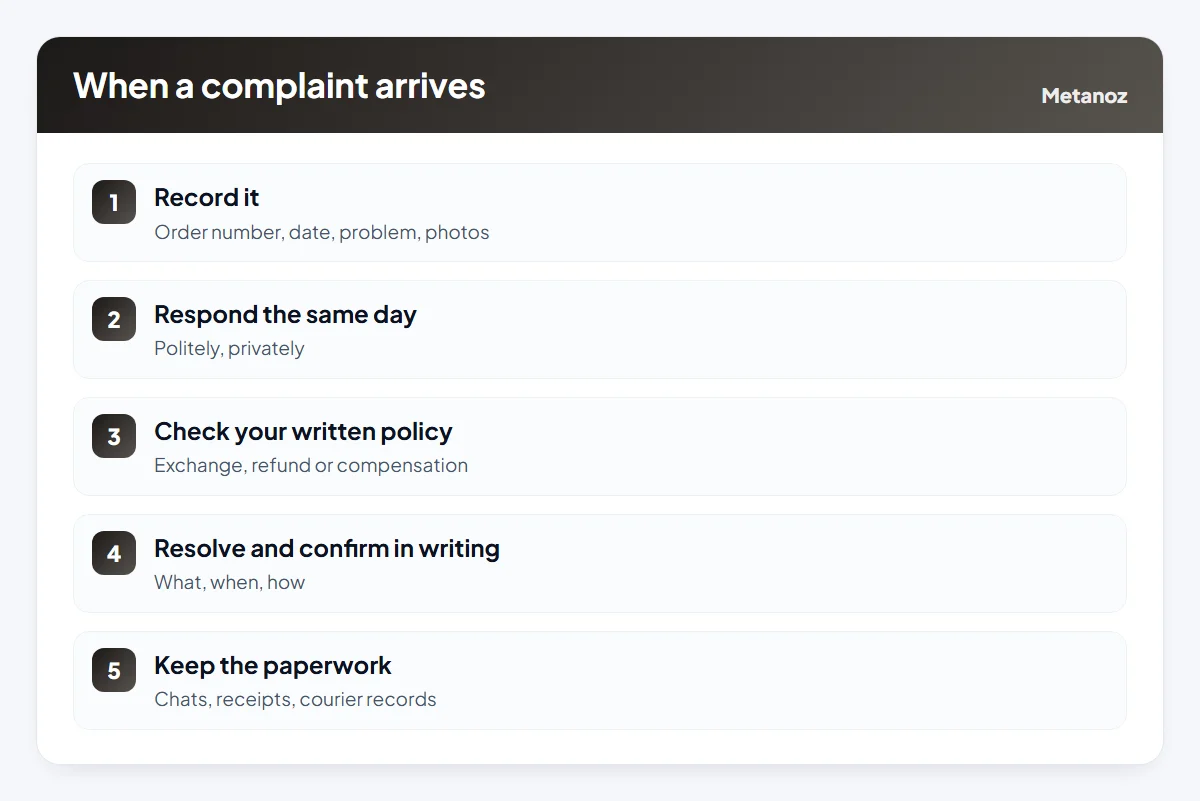
If you receive a hearing notice, do not ignore it. Bring your order records, chats, payment confirmations and courier receipts, and get legal advice if the matter is serious.
When to get advice
A lawyer or tax adviser is worth paying for when you:
- take large advance payments or run pre-order campaigns;
- sell regulated goods such as food, cosmetics, supplements or medicine;
- import goods for resale or sell abroad;
- run a marketplace where other sellers sell through your site;
- receive a formal complaint, hearing notice or legal letter;
- are deciding whether to register as a company.
Putting it on your website
- Product pages: real photos, full description, price, stock and delivery estimate.
- Checkout: total including delivery, payment options, a link to your refund policy.
- Policy pages: refund and returns, delivery, privacy, terms.
- Contact page: business name, address, phone, how to complain, and registration numbers where appropriate.
- Records: every order with its date, payment, status and courier details, kept safely.
On Metanoz, the online store (Business plan; contact us for pricing) shows each product's price, stock and description, adds area-based delivery charges to the total at checkout, and keeps every order with its status and payment record in one list. Policy and contact pages are ordinary pages you can add, including ready-made pages such as FAQ and Contact. The selling guides in the Help Center cover the setup. The policies themselves, and keeping to them, remain your responsibility; software only helps you present them clearly.
What to do next
Look at your shop as a customer would: can you see the total price, the delivery time, the refund rules and who the seller is before ordering? Fix what is missing this week. Then check which papers you already have, and plan the rest, starting with a trade licence.
Start your website today
Pick a template and a name; Metanoz sets up the rest. 7 days free, no card needed.
Start freeSee templatesFrequently asked questions
Do e-commerce rules apply to Facebook-only sellers?
Yes. Consumer rights law applies to anyone selling to consumers, and the Digital Commerce Guidelines cover online selling generally, including through social media pages.
What is the delivery time limit for online orders in Bangladesh?
As we understand the guidelines, generally 5 days within the same city and 10 days for other cities or rural areas, with exceptions. Check the latest version of the guidelines, and state your real delivery times on your site.
How quickly must I refund a customer?
The guidelines set a time limit for refunds when an order cannot be delivered; as we understand it, generally within 10 days, through the same payment channel. Write your refund timing into your policy and keep to it.
Do I need a DBID to sell online?
DBID was introduced for online businesses, and payment gateways or marketplaces may ask for it. Check the current requirements with the Ministry of Commerce's DBID system.
Can I be fined for a customer complaint?
If the Directorate of National Consumer Rights Protection finds a violation after a hearing, it can impose a fine. Responding quickly and resolving complaints directly usually prevents it getting that far.
Is this legal advice?
No. It is a general overview as of October 2026. Rules change, so confirm with official sources and a qualified adviser for your situation.
 অনলাইন ব্যবসার ট্রেড লাইসেন্স ও ই-ক্যাব সদস্যপদ: কী লাগে, কীভাবে করবেন
 ভোক্তা অধিকার আর অনলাইন বিক্রেতা: যে নিয়মগুলো জানা জরুরি
 Trade Licence for an Online Business in Bangladesh: Papers, Steps, Fees